


Each theme is a different way of looking at art.
Choose the one that intrigues you most - or let curiosity lead the way.


Paul Cézanne, 'Mont Sainte-Victoire Seen from the Bibemus Quarry', 1897
Reinventing Vision
Modern art marks a shift from what the world looks like to what it feels like. From intellect to intuition. From the academic to the sublime.
Brushstrokes become visible, color conveys emotion, and the familiar world begins behaving very strangely. Looking closely at just a few works, we’ll see how artists reinvented painting—and forever changed how we look at a lily pond.
(And like all good things, it begins with the British.)
What the Fuscia?!?
Long before The Hitchhiker’s Guide to the Galaxy, some artists suspected that art might contain the answer to the Ultimate Question: the meaning of life, the universe, and everything.
The Abstract Expressionists pursued that ambition using a colorful language several degrees removed from reality.
Like a drunk guest at a party who won’t stop talking about a recent breakup, these paintings almost dare you not to like them. Fortunately for us, they fail completely.

Adolph Gottlieb, 'Expanding', 1962

When Emotions Went to 11
Fast on the heels of the Renaissance came the Baroque: a bonkers period that transformed painting into a full-blown emotional experience with a larger-than-life cast of characters.
Across Europe, artists went full Hollywood using light, movement, and dramatic storytelling to reach out and pull viewers straight into the scene. Looking closely at works by Rubens, Veronese, Georges de La Tour, Zurbarán, and Murillo, we’ll see how painters used color, gesture, and candlelight to create images meant not only to be admired—but felt.
Caravaggio, 'David With the Head of Goliath, 1609-1610
About-Face!
“From its mythic beginnings—portraiture has always tried to capture humanity’s image of itself.”
— Andreas Beyer
In this experience we test that idea through three very different artists: a gambler who blew his earnings in Monte Carlo, a lover who treated romance like a Las Vegas buffet, and a painter with a suspicious habit of outsourcing his backgrounds to China.
The result is a lively conversation about what it means to see—and to be seen—while encountering some of the most extraordinary brushwork in the museum.

Jean-Auguste-Dominique Ingres, 'La Comtesse d'Haussonville, 1845

Suzuki Harunobu, 'Young Samurai Viewing Cherry Blossoms as a Mitate of Prince Kaoru', 1767.
Who Left the Ink on?
Japanese art is extraordinary, and the seventeenth century is when it truly begins to sing.
After generations of war, Japan entered a long period of peace. What had been an ocean of blood gradually became a river of ink—mingling with gold, pigment, and poetry as it flowed across ceramics, folding screens, and woodblock prints.
This was the world of Edo: palaces and pleasure districts filled with elegant dress, spontaneous brushwork, romance, and reverie. Looking closely at a few remarkable works, we’ll see how artists used line, space, and suggestion to transform the way we see.
Buddh-Oh!
Most people think Buddhism centers on a man and a noun. In fact, it begins with an event and a verb.
This experience pulls back the curtain on one of the world’s oldest religions to reveal why. Our journey follows the unfolding of Buddhist art across Asia—beginning with the remarkable cultural meeting of Persians, Greeks, and Indians in the ancient kingdom of Gandhara, before spreading across the continent.
Looking closely at a few remarkable works, we’ll discover artistry that captures the spark of insight that lies in all of us, and renders it in three dimensions.

Amida Buddha, Japan, ca.1130
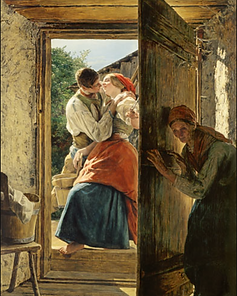
Friedrich von Amerling, 'The Kiss', 1835
Surprise Me!
The late, great, and slightly batty Marcel Proust once observed that discovery isn’t just about traveling to new lands—it’s about learning to look with fresh eyes.
In this experience, we get to do both, sharing in a new way of seeing that is only made possible by us.
I'll take any guidance or instructions you want to share, the rest you can leave to me.
(And if you truly want to spin the wheel, feed me an emotion, a star sign, a chord, or a color. We'll have so much fun.)