


How to look at a painting.
- Stefen
- Jan 30
- 4 min read
Updated: Feb 14
Looking at painting is so much fun because, like ayahuasca and jhana meditation, you can experience it on so many levels. There’s the standing back, and the taking it in. That feeling of attraction, bemusement, or visceral dislike. And then there’s the journeying deeper, which less of us take, where one can move below the surface to explore the creative tension that is the act of painting. I want you to tap into that energy yourself and my aim in this post is to describe how.
For me, any work of art - no matter how great or face-slappingly bad - is about revelation. It’s a deep and subtle magic that conjures up as much about you and that friend of yours standing next to you as it does about the artist; and almost all the clues you need are right there in the painting.
My first step is not to look at the caption next to the painting: it’s bound to be annoying, distracting and intrusive in equal measure. I start with a variation on a meditation technique taught me by the monastics at the Monastery I attend. It goes something like this: everything is connected to everything else and arises codependently. Concepts of self are no less arbitrary than a nation’s borders. They are just lines drawn through something, maintained by an act of will. To appreciate the whole, you have to simultaneously hold the parts in view. Looking at the surface of a lake, do you see the ripples moving across it, the reeds growing up from its bed, or do you see the water being suspended in between? Now try holding all three views at once.
Like most of us, painters cannot hold everything in view at once. They inevitably make trade offs, and the trade offs they make tell us something about where they were choosing to direct their attention, and what they might have been feeling.
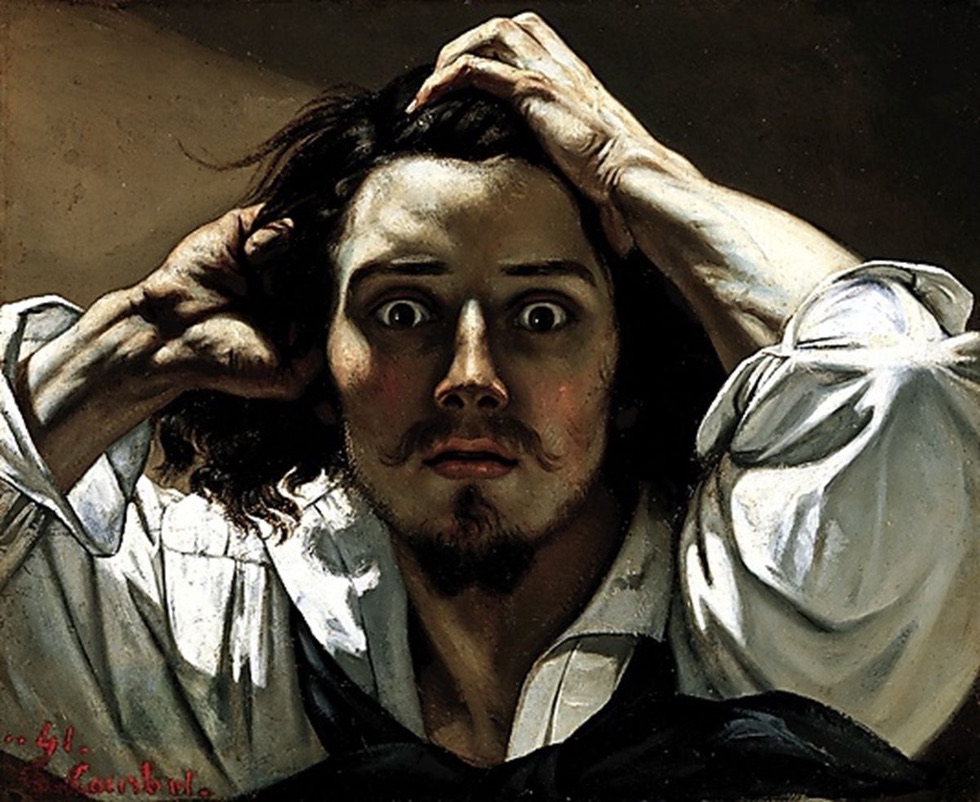
I step back five paces to focus first on the surface of the canvas. I look at the lines and where they are going. Do they move across the canvas to create a sense of breadth? Are they organized vertically to draw my gaze upward, or are they slicing away on a diagonal to insert a sense of realism or drama? Are they executed in a rush, or are they meticulously placed? Are they of one color, or many? Lines describe borders. They are the arrangement of an energy the artist is trying to share with you.
While standing back from the canvas, I let my eye move from lines to colors. How many are there? Are they hot or cold? Dark or light? Do they complement or clash? What do they suggest about the artist’s state of mind? Do they suggest he was happy, or tortured? Taking his time, or in a hurry?
From colors and lines, I can shift to shapes and forms. Are they sharply delineated or lightly, perhaps imperceptibly, traced; emerging from, or receding into shadow? Are they recognizable or distorted in any way? Is the artist trying to record exactly what anyone else might see, or is his view colored in some way. Is his perspective off, or true to life? Do things look jumbled, or neatly arranged? Piecing lines, colors, shapes and forms together, a narrative starts to take shape. I can now place myself at the scene.
Now comes my favorite part: I take five steps forward to enter the painting. I’m looking for fingerprints on the canvas (sometimes literally), the little tell-tale signatures and techniques that tell me something about the artist’s skill and frame of mind. What materials is she using? Is it just paint, or other media too? Is she mixing her oils first, or squeezing straight from the tube? Can I see the tell-tale trace of bristles being dragged across the surface, or not? If not, why is she disguising her technique? Is she pushing or pulling her paint using palette knives, brushes, fingers, sponge mops, or squeegees (favorite tools of the American painter Adolph Gottlieb)? I’m particularly interested in any passages where paints meet, those borders where colors collide and merge. Artists like the irascible twentieth century painter Clyfford Still would use them to describe moments of turmoil and drama in which he literally man-handled the paint into submission to his fiery will, while a virtuoso like the nineteenth century painter John Singer Sargent worked them across the painterly equivalent of a Whitney Houston four-octave range.
At this point I can settle back from the “form” of a painting to its subject. Subjects in painting, as in real life, are fabrications, visual constructs of our own making. They do not exist objectively out there in space. Without the observer, there is no observed. Like a magician, painters trick us into seeing something that strictly speaking, isn’t there.
So what do you see, and how do you feel in this present moment? To quote the Flaming Lips: “all we ever have is now”. So pay attention to your thoughts and emotions, because at the end of the day, as you stand there holding the parts in view, the whole that emerges says as much about you as it does about the artist. It’s beautiful, and it’s fleeting. And that’s the nature of revelation.


Comments